
Kakeibo App Comparison: 4 Money Apps to Quiet Financial Anxiety
Comparing 4 kakeibo apps by the anxiety they solve: Money Forward ME, Zaim, OsidOri, Moneytree.
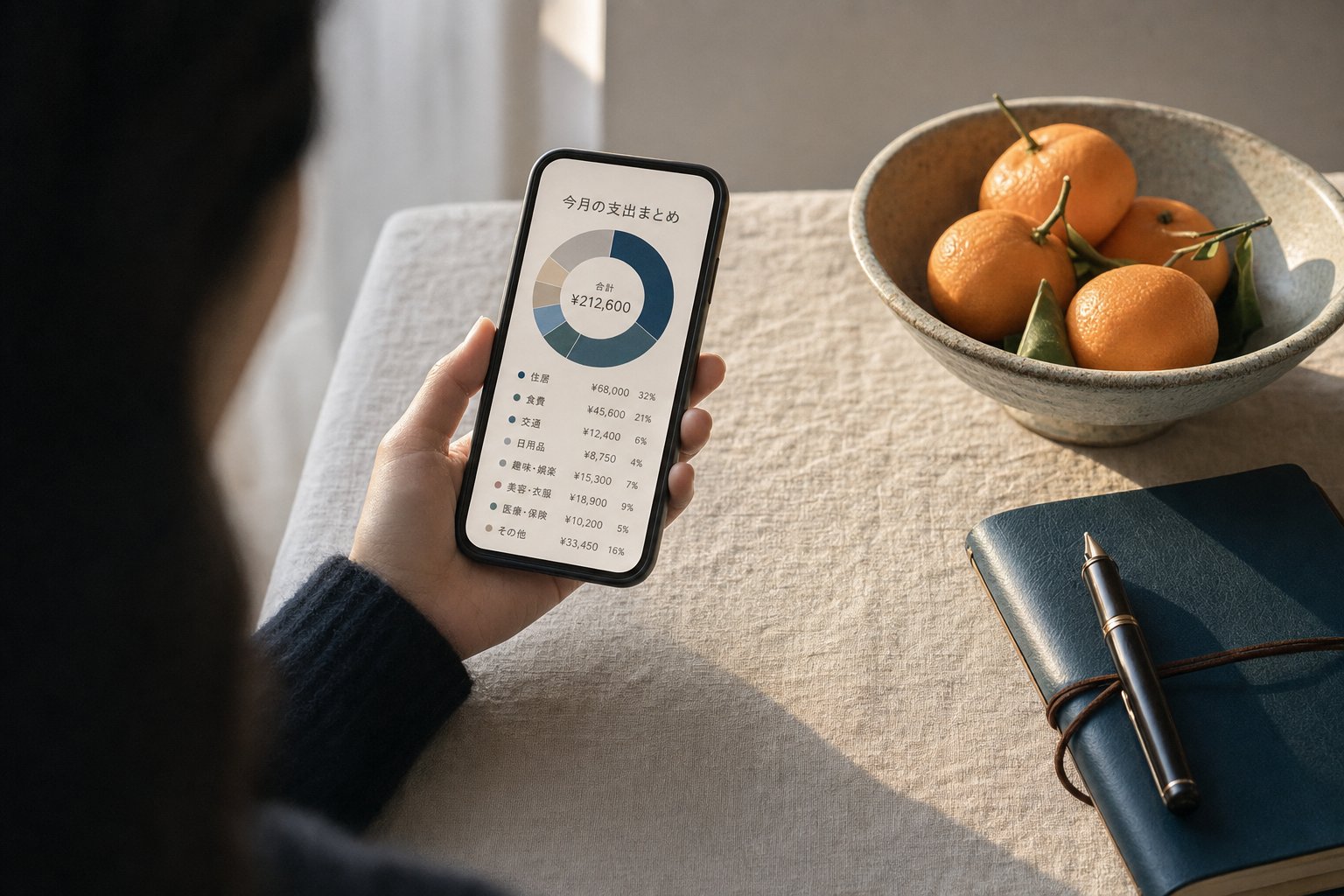
Can you say exactly how much is in your bank account right now? When that question makes you freeze, the anxiety isn't really about the number—it's about not seeing it. Kakeibo, the household ledger invented by Motoko Hani in 1904 for Japanese housewives, has since traveled abroad and returned to us as a global wellness idea, covered by the New York Times and the Guardian. The notebook became an app, but the logic is unchanged: once money becomes a number you can see, the fear becomes something you can hold. Here we compare four major apps used in Japan, sorted by which anxiety each one actually solves. **
What is a Kakeibo App? A Tool That Turns Anxiety Into Numbers
There's a term called money dysmorphia—a gap between your actual finances and how poor you feel. A 2024 Credit Karma survey found 43% of Gen Z and 41% of millennials experience it. Revenge saving, where higher earners hoard obsessively out of scarcity fear, grows from the same root. Both share one cause: not looking at the numbers. Japan's Statistics Bureau Household Survey (2024) also shows households that keep a kakeibo tend to have significantly higher savings rates. Which means a kakeibo app is, before anything else, a therapy device that dissolves money dysmorphia with data.
Why Japanese Kakeibo Culture Fits the App Format So Well
Why does Japan's kakeibo culture pair so naturally with apps? Three reasons. First, kakeibo was itself an invention of category-based accounting—exactly the logic behind automatic transaction tagging. Second, Hani's monthly cycle of budget → record → reflect maps cleanly onto the monthly report feature of every modern app. Third, Japanese household finance is unusually fragmented across accounts (salary, spending, savings, brokerage, e-money), making the need for unified dashboards among the strongest in the world. So the question isn't which app is best—it's which anxiety you want to quiet: seeing everything, sharing with a partner, or watching total net worth.

How to Start With a Kakeibo App: 4 Steps by Anxiety Type
Our editors compared four major apps by the anxiety each one solves. Pricing and integrations shift, so verify current details on each official site.
- 【Money Forward ME】— For those who need to see everything. Broad auto-sync across banks, cards, brokerages, and e-money; one screen for cash flow and net worth. The default choice, usable free.
- 【Zaim】— For those who want receipt-level control. Strong receipt OCR and a signature feature that compares your spending to national household survey data. Best for manual-entry lovers.
- 【OsidOri】— For couples who don't want money to become a fight. Two wallets in one app (personal + shared), with the option to hide private spending. Designed to protect the psychological safety of dual-income households.
- 【Moneytree】— For those who want to quietly watch total assets grow. Minimal ads, calm UI, and unified view of investments and pensions—ideal for long-horizon net-worth tracking. Start with
- or
- for the big picture, layer
- or
- as needed. Related: Cash Stuffing pairs well with any app to restore the physical feel of spending.
The Takeaway: Choosing Your First Kakeibo App
The cheapest way to quiet money anxiety isn't investing or side-hustling—it's looking. Pick the one app closest to your anxiety, connect just one account, and give it a week. Seeing your balance and spending, plainly, changes the internal weather more than you'd expect. Money Forward ME, Zaim, OsidOri, and Moneytree all offer free tiers to start. You can compare and sign up via the links below—if you're torn, use this shortcut: 「see everything」= Money Forward ME, 「share with a partner」= OsidOri, 「quietly track net worth」= Moneytree. Numbers don't judge you. They just give you an outline.
About this article
This article was produced by the Tokyo Decoded editorial team. We cite sources, verify facts, and keep editorial independence from advertisers. See our editorial policy.