
No-Buy 2026 Mid-Year Reset: Rebuild Your Challenge with Systems, Not Willpower
Failed your No-Buy year? July is the reset point. 44% of Americans are trying it—here's how to rebuild.
"This is the year I stop buying." Sound familiar? If you made that vow in January and now, opening your wallet in July, you're wondering where it all went wrong—you're not alone. Half a year in, many No-Buy 2026 participants hit a wall: a sale purchase here, a midnight impulse click there, small convenience-store indulgences that added up. But here's the reframe happening across US YouTube right now: "mid year no buy update" videos have become a whole genre, and the consensus is that failure isn't failure—it's a signal your rules need redesigning. July is the halfway point. Reset your system now, and the next six months can actually feel lighter than the first.
What is the No-Buy Challenge? 44% of Americans Are In
The No-Buy Challenge is a time-boxed experiment: buy nothing beyond essentials for a set period. TikTok's #nobuychallenge has racked up roughly 4.9 million posts, and Reddit's r/nobuy community passed 70,000 members as of July 2026 (Yahoo Finance, July 3, 2026). An Intuit Credit Karma survey cited by Entrepreneur (June 16, 2025) found 44% of Americans are doing or planning a low-buy year and 42% a full no-buy year. The driver is a quiet revolt against inflation and the hollowness of "buying more, feeling less." In Japan, personal bloggers and note.com writers have been documenting kawanai chōsen ("the not-buying challenge") since 2025—a natural extension of Japan's mottainai ethic, Underconsumption Core, and the deinfluencing movement.
Why July Is the Breaking Point: The Structural Flaw in Willpower Saving
People who quit at the six-month mark don't have weak willpower—they have three design flaws in their rules. First, the rules are too extreme (a total buy-ban is not humanly sustainable). Second, the exception list is fuzzy (What about cosmetics? A friend's wedding gift?). Third, there's no logging system, so wins remain invisible. The US No-Buy community calls this the "black-and-white trap." Japan's own kakeibo (household ledger) tradition, born in 1904, was never about deprivation—it was about observing yourself in dialogue with your spending. Reframe No-Buy the same way: not as "resisting purchases" but as "making buying decisions conscious." Whether it's the public accountability of Loud Budgeting or the controlled rebound of revenge saving, the people who succeed run on systems, not grit.
How to Reset Your No-Buy: A 5-Step Mid-Year Rebuild
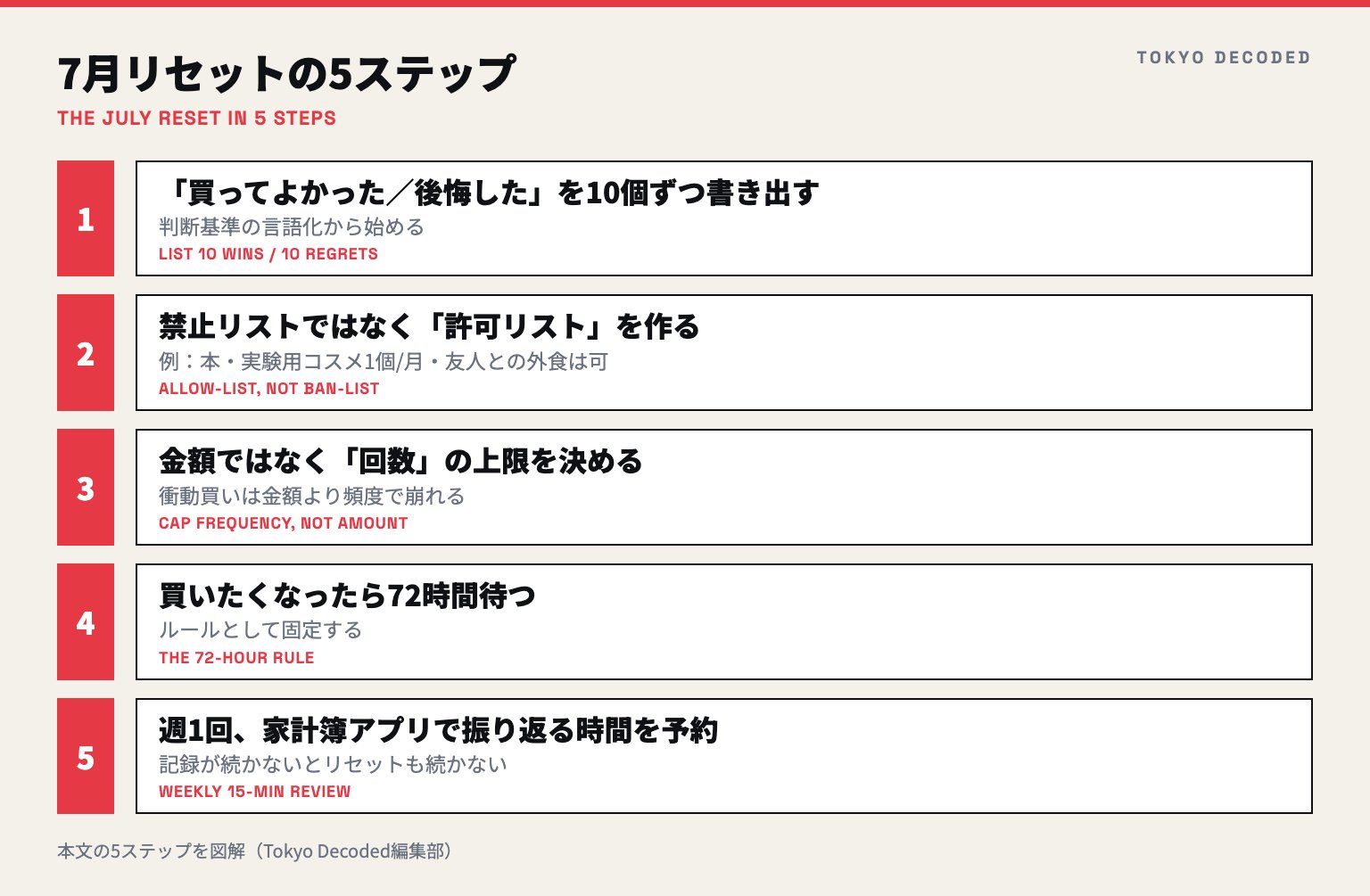
A July reset works best in five steps.
- Write down 10 purchases you're glad you made and 10 you regret from the first half—this verbalizes your criteria.
- Replace the ban list with a permission list (e.g., books, one experimental cosmetic per month, meals with friends are OK).
- Set a frequency cap, not a spending cap—impulse buying breaks down by frequency more than by amount.
- Install a 72-hour waiting rule for any want.
- Book a weekly 15-minute review in a budgeting app. Step 5 is the hinge; without logging, resets don't stick. Reviewing the free budgeting apps available in Japan, three consistently surface: Money Forward ME (best receipt-scanning + bank sync), Zaim (lowest quit rate thanks to simplicity), and OsidOri (best for couples/family sharing)—see our budgeting app comparison. For the deeper "why do I buy?" work, books like Bill Perkins' *Die With Zero* and Elizabeth Dunn's *Happy Money* help decouple spending from happiness.
The Takeaway: No-Buy Runs on Systems, Not Willpower
If July has you thinking "maybe I can't do this," that's not failure—that's a design signal. What keeps No-Buy 2026 alive for the remaining six months isn't tighter bans; it's a logging system you'll actually keep. Install one budgeting app today and block 15 minutes a week to review (our kakeibo-app comparison above covers how to choose). For the deeper reset, *Die With Zero* by Bill Perkins is the book No-Buy practitioners keep recommending in mid-year update videos — the links below have details and reviews. Make one July week your "system rebuild" week, and the back half of the year gets lighter.
About this article
This article was produced by the Tokyo Decoded editorial team. We cite sources, verify facts, and keep editorial independence from advertisers. See our editorial policy.