
Sinking Funds: The FinTok Method for Predictable Surprises
Car inspections, holidays, birthdays — build monthly savings for predictable irregular expenses.
"Broke again this month — car inspection got me." The expense you knew was coming, yet somehow it always feels like an ambush. Enter sinking funds: the FinTok-favorite method of setting aside monthly cash for predictable but irregular costs. Japanese households have long done this as tokubetsu-hi tsumitate (special-expense savings). Let's translate the global playbook into a system that fits Japanese life.
What are sinking funds? The data behind the trend
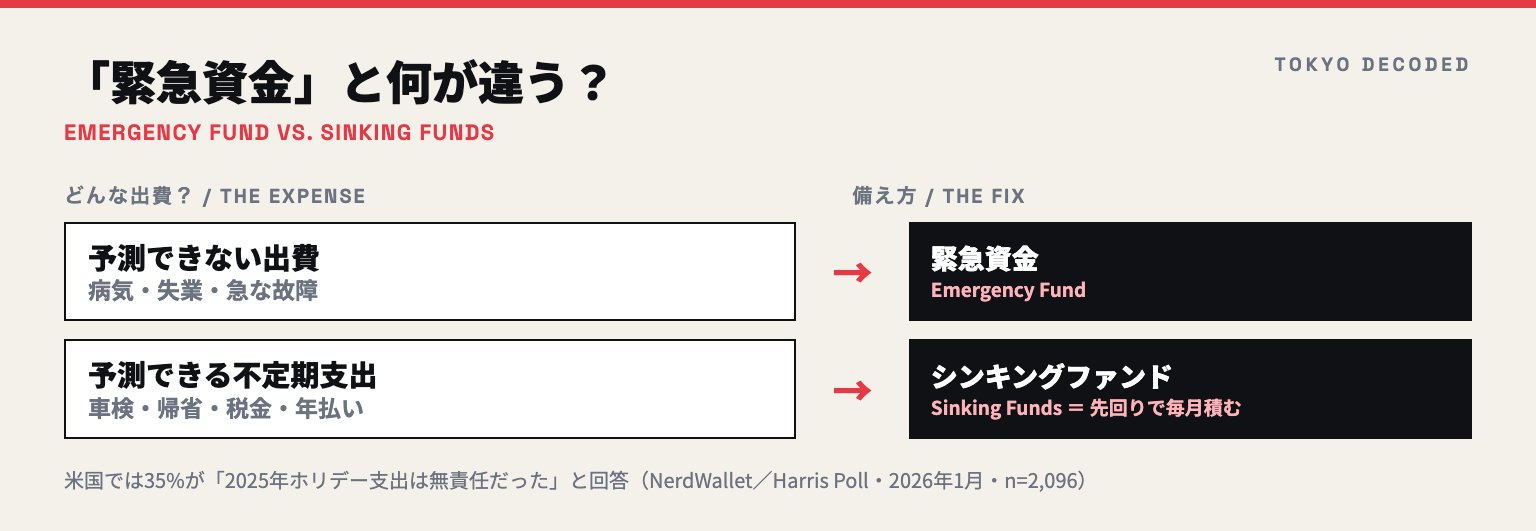
A January 2026 Harris Poll for NerdWallet (n=2,096) found 35% of Americans called their 2025 holiday spending "financially irresponsible." Among those who charged 2024 holidays to credit cards, 31% still hadn't paid off the balance nearly a year later. Bankrate's 2026 Emergency Savings Report adds that only 41% of Americans could cover a $1,000 emergency from savings. Ramsey-affiliated creators like Rachel Cruze keep sinking funds evergreen precisely because this gap — predictable expenses meeting no plan — is where budgets break. The concept overlaps with Japan's long-standing cash stuffing tradition.
Why it works: sinking funds vs. emergency funds
The key is distinguishing sinking funds from emergency funds. Emergency funds cover the unpredictable — job loss, medical shocks, a fridge dying overnight. Sinking funds cover the predictable-but-irregular: car inspections (shaken every two years in Japan), property tax, New Year travel home, back-to-school costs, year-end gifts. You know these are coming; they just don't show up in a monthly budget. Divide the annual estimate by 12 and stash it monthly, categorized by purpose. Japanese kakeibo culture has done this for decades under the name tokubetsu-hi. FinTok simply gave the practice a systematized English name — and a wave of dedicated apps.
How to start sinking funds — a 4-step setup
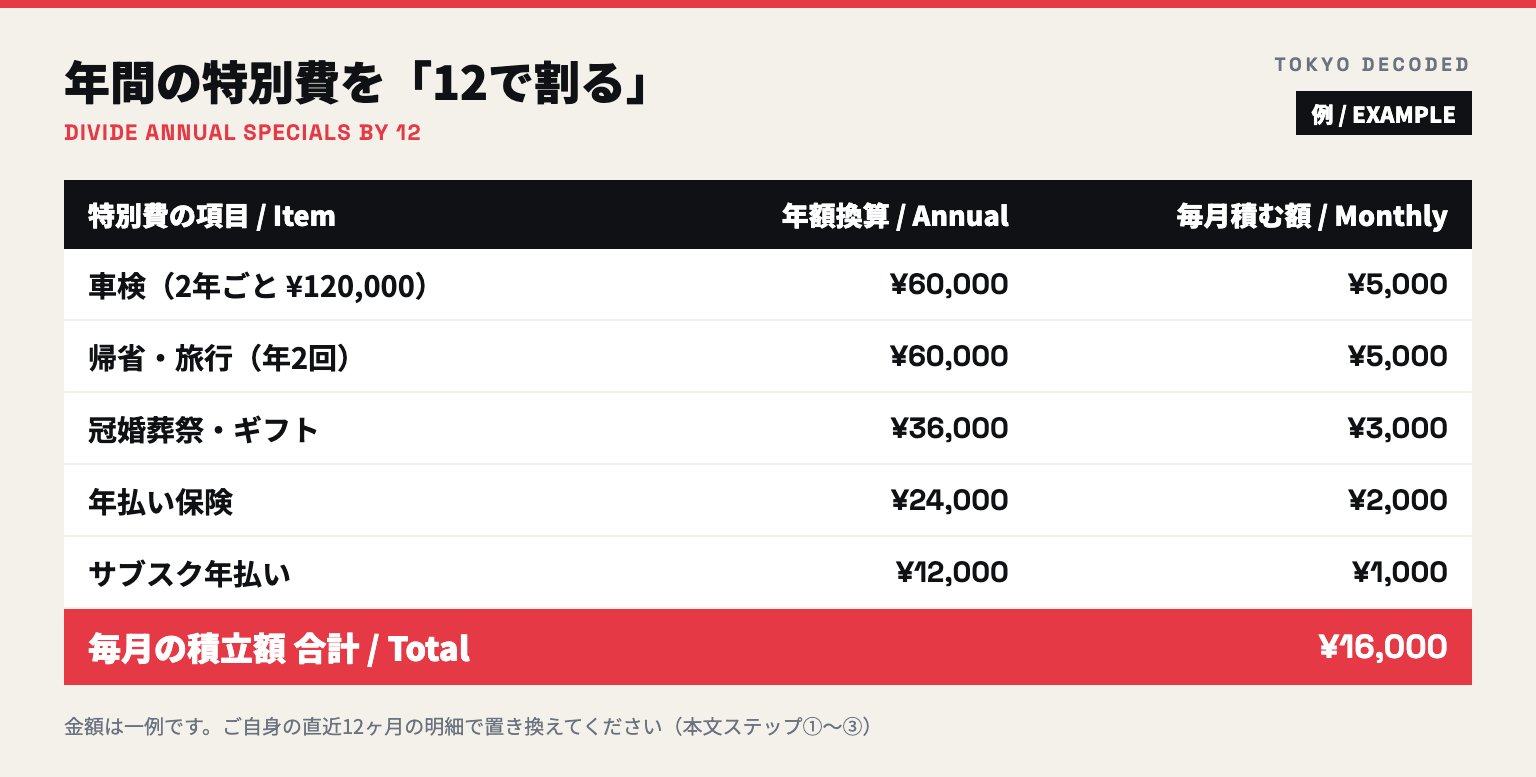
- Audit twelve months of statements and list every non-monthly expense (car inspection, taxes, family visits, weddings, birthdays, annual subscriptions, insurance premiums).
- Assign an annual estimate to each category — err generous.
- Divide by 12 to get the monthly deposit. Example: ¥120,000 shaken every two years = ¥5,000/month. Check the total fits your current budget.
- Automate visibility. From the tools we tested, Money Forward ME auto-syncs multiple accounts and lets you tag expenses by purpose, while Zaim allows custom categories perfect for sinking-fund labels. Rakuten Bank's "purpose-based sub-accounts" (mokutekibetsu koza) let you physically separate the cash. Once automated, willpower stops being the bottleneck.
The takeaway: kill the annual surprise
Car inspections, family trips, New Year gifts — they're coming next year, guaranteed. Sinking funds simply move them into your monthly budget before they arrive. Start today by listing one non-monthly expense and dividing its annual cost by twelve. Then pick a categorized budgeting app to automate visibility — our kakeibo-app comparison above breaks down which app fits which anxiety. Tokyo Decoded's Digital Kakebo worksheet is also free if you want to sketch your annual special-expense map on paper first.
About this article
This article was produced by the Tokyo Decoded editorial team. We cite sources, verify facts, and keep editorial independence from advertisers. See our editorial policy.